This website contains affiliate links. Some products are gifted by the brand to test. As an Amazon Associate, I earn from qualifying purchases. The content on this website was created with the help of AI.
You’re about to buy a dog crate and there are 400 options on Amazon. Wire ones, wooden ones, fabric ones, steel ones that look like they belong in a prison movie. Every review says “best crate ever.” None of them tell you which type is actually right for your specific dog and your specific situation.
Here’s what nobody explains: there are really only five types of dog crates, and each one is designed for a completely different scenario. Pick the right type and crate training is easy. Pick the wrong one and you’ll be returning it within a week. This guide tells you which type you need — and just as importantly, which types to skip.
The Wire Crate: Best for Puppies and Training

Get this if: You’re crate training a puppy, you want your dog to see you (and you to see them), or you need a crate that grows with your dog. Wire crates come with a divider panel that lets you make the crate smaller for a puppy and expand it as they grow — which means you buy one crate instead of three. They fold flat for storage, have a removable tray for easy cleanup, and the open wire design gives maximum airflow and visibility.
Skip this if: Your dog has separation anxiety, is a serious escape artist, or you need something that looks good in your living room. Wire crates are functional, not decorative. And a determined dog can bend wire bars — if your dog has ever broken out of a crate, skip ahead to the heavy-duty section.


The Furniture Crate: Best for Living Rooms and Small Spaces
Get this if: Your dog’s crate lives in a shared space and you’re tired of looking at a metal cage in your living room. Furniture crates look like end tables or credenzas — they have a flat top you can put a lamp or plant on, and the crate is built into the frame. Guests don’t even notice it’s a dog crate. If you live in an apartment or a smaller home where the crate is always visible, this is the one that makes you stop resenting it.
Skip this if: Your dog is still in the chewing phase, is a heavy chewer, or weighs over 70 lbs. Furniture crates are made of wood and metal mesh — they’re sturdy for calm dogs but not built to survive a determined chewer. They’re also heavier than wire crates and don’t fold down, so they’re not great for travel.

The Soft-Sided Crate: Best for Travel and Calm Dogs
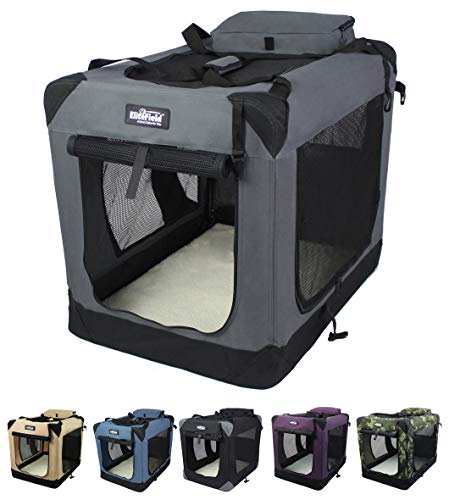
Get this if: You travel with your dog, camp, visit family, or need a crate you can throw in the car and set up in 30 seconds. Soft crates fold down to almost nothing, weigh a fraction of wire or steel crates, and come with carrying bags. They’re also quieter — no rattling metal when your dog moves around. For an already-trained, calm dog who just needs a familiar space on the go, a soft crate is the most practical option.
Skip this if: Your dog chews, scratches, or has any escape tendencies. A determined dog will unzip or claw through a soft crate in minutes. These are strictly for dogs who are already crate-trained and comfortable. They’re also not suitable for puppies who are still learning.
The Heavy-Duty Crate: Best for Escape Artists and Anxiety
Get this if: Your dog has bent wire bars, broken out of a standard crate, or has severe separation anxiety. Heavy-duty crates are made from 20-gauge steel with reinforced welds and dual-latch doors. They’re designed for the dogs that destroy everything else. If you’ve already been through a wire crate and a soft crate and both failed, this is what you need — and you’ll wish you’d bought it first instead of wasting money on two crates that didn’t hold up.
Skip this if: Your dog is calm, small, or already crate-trained without issues. Heavy-duty crates are expensive, extremely heavy (the 48-inch models weigh 80+ lbs), and overkill for a dog that doesn’t need them. They also don’t fold flat — they have lockable wheels instead because you’re not carrying this anywhere.

The Plastic Kennel: Best for Air Travel
Get this if: You’re flying with your dog in cargo, driving long distances, or need an IATA/airline-compliant crate. Plastic kennels are the only type that meets airline cargo requirements. The hard shell protects your dog during transit, the ventilation holes provide airflow without exposure, and the design gives dogs a more enclosed, den-like feeling that many dogs actually prefer. Some dogs who hate wire crates do much better in plastic kennels because the enclosed space feels safer.
Skip this if: You’re not traveling by air and your dog doesn’t prefer enclosed spaces. Plastic kennels are bulky, don’t fold down, and provide less visibility than wire crates. They’re purpose-built for travel safety — if you need an everyday home crate, one of the other four types will serve you better.

The Quick Decision Guide

Still not sure? Answer one question:
New puppy? Wire crate with divider. Always.
Crate in your living room? Furniture crate.
Dog travels with you? Soft-sided crate.
Dog has broken out before? Heavy-duty steel.
Flying with your dog? Plastic kennel, airline-approved.
Don’t overthink it. Match the type to your situation, pick the one product recommended in that section, and you’re done. The right crate for your dog isn’t the one with the most reviews — it’s the one built for what your dog actually needs.
This post contains affiliate links. As an Amazon Associate, I earn from qualifying purchases.
This website contains affiliate links. Some products are gifted by the brand to test. As an Amazon Associate, I earn from qualifying purchases. The content on this website was created with the help of AI.
