This website contains affiliate links. Some products are gifted by the brand to test. As an Amazon Associate, I earn from qualifying purchases. The content on this website was created with the help of AI.
Turn Your Fabric Scrap Pile Into Décor That Looks Boutique-Made
Twenty simple, budget-friendly projects that turn every leftover flannel square, linen hem, and quilting scrap into baskets, vases, gifts, and décor you’ll actually use.
Shop the Fabric Scrap Craft Kit →Affiliate links · As an Amazon Associate I earn from qualifying purchases.

If you’ve ever had a basket (or five) overflowing with fabric scraps, you’re in good company — they multiply the second you’re not looking, little squares of flannel, torn linen hems, and leftover quilting bits too pretty to throw away. Pinterest finally convinced me they deserved better than the trash bin, and honestly, it was right: these tiny leftovers turn into some of the most charming, functional, and downright satisfying DIYs you’ll ever make, from no-sew baskets to patchwork vases and soft drawer liners. Here is exactly how to turn your leftover scrap pile into twenty pieces of cozy, handmade, farmhouse-feel décor, gifts, and accessories.
Twenty projects, four easy categories
Home décor & accents
Vases, candles, wall art, garland, and more turn scraps into cozy farmhouse touches.
Gifts & keepsakes
Keychains, bookmarks, and fabric gift wrap make thoughtful, handmade presents.
Wearables & bags
Aprons, totes, scrunchies, and travel pouches you’ll actually reach for every day.
Storage & organization
No-sew baskets, key holders, and storage bins that tidy up while looking pretty.
The classic decor pieces
No-Sew Fabric Scrap Basket

I saw this cozy little rope basket made from old fabric scraps, and before I knew it, I was cutting up an old flannel shirt I hadn’t worn since college. There’s something so satisfying about turning “trash” into something that could live on a coffee table filled with pinecones or yarn. It’s rustic, soft, and way too cute to believe it used to be clutter.
How To:
- Cut fabric scraps into strips about 3–4 inches wide and 8–10 inches long. Cotton, flannel, and linen all work beautifully.
- Cut a length of sturdy rope (⅓–½ inch thick) to about 28–30 inches — enough to form a circle the size you want for your basket rim.
- Shape the rope into a circle and secure the ends tightly together with hot glue or by wrapping tightly with twine until firm.
- Fold one fabric strip in half to find the midpoint. Place the folded loop over the rope, then pull both loose ends down through the loop and tighten — this is called a lark’s head knot. It takes seconds and holds firmly.
- Continue adding strips all the way around the rope hoop, packing them closely together so no rope shows through.
- Once the entire rim is covered, your fabric strips will hang down naturally to form the basket sides. Gather the bottom edges together and tie tightly with twine, or hand-stitch across the bottom to close the base.
- Optional: cut a circle of stiff fabric or felt and hand-stitch it to the bottom for a cleaner look.
Shopping List
Do: pack your strips tightly — no gaps means a fuller, sturdier basket.
Do: alternate fabric colors and patterns as you go for a beautiful stripe effect.
Don’t: use rope thinner than ⅛ inch — it won’t hold its circular shape.
Don’t: overload it with heavy items — it’s decorative, not structural.
Patchwork Fabric Vase Wraps
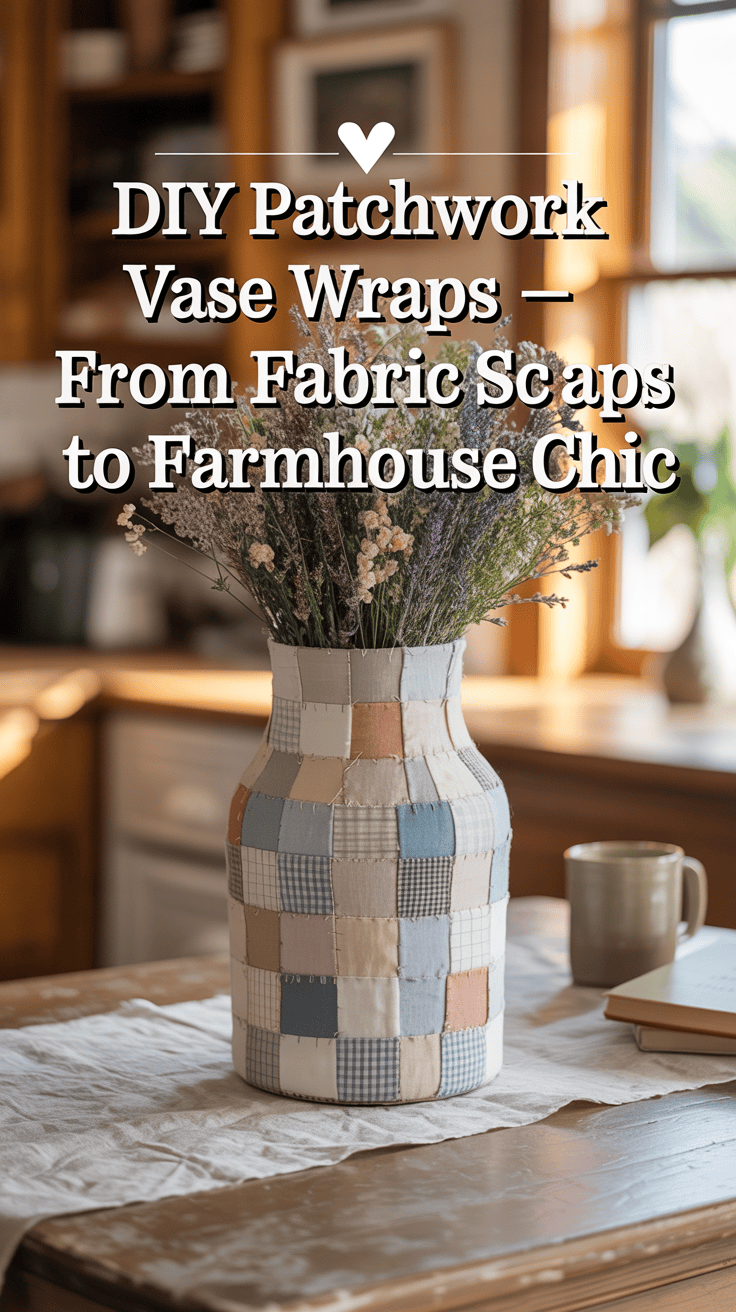
Pinterest got me again with this one — a picture-perfect mason jar wrapped in tiny fabric squares that looked like something straight out of a farmhouse café. I had leftover gingham, floral, and linen scraps, and I couldn’t resist giving my plain vases a rustic, cozy makeover. Now they sit on my windowsill catching morning light, looking like a DIY success story.
How To:
- Collect fabric scraps in complementary tones — 4–6 colors work best.
- Cut each scrap into 2×2-inch squares.
- Lay the squares side by side on your table and plan the pattern before gluing.
- Brush a thin layer of Mod Podge or fabric glue directly onto a clean glass vase or jar.
- Apply your fabric pieces one at a time, overlapping slightly for a quilted look.
- Smooth out air bubbles with your fingers or a dry brush.
- Once covered, seal with one more light coat of Mod Podge and let dry overnight.
Do: use lightweight cotton or linen — they lay flatter and absorb glue better.
Do: trim excess fabric along the rim for a neat finish.
Don’t: skip sealing — unsealed edges will fray over time.
Don’t: use thick upholstery fabric — it won’t curve smoothly around glass.
Fabric Scrap Candle Wraps
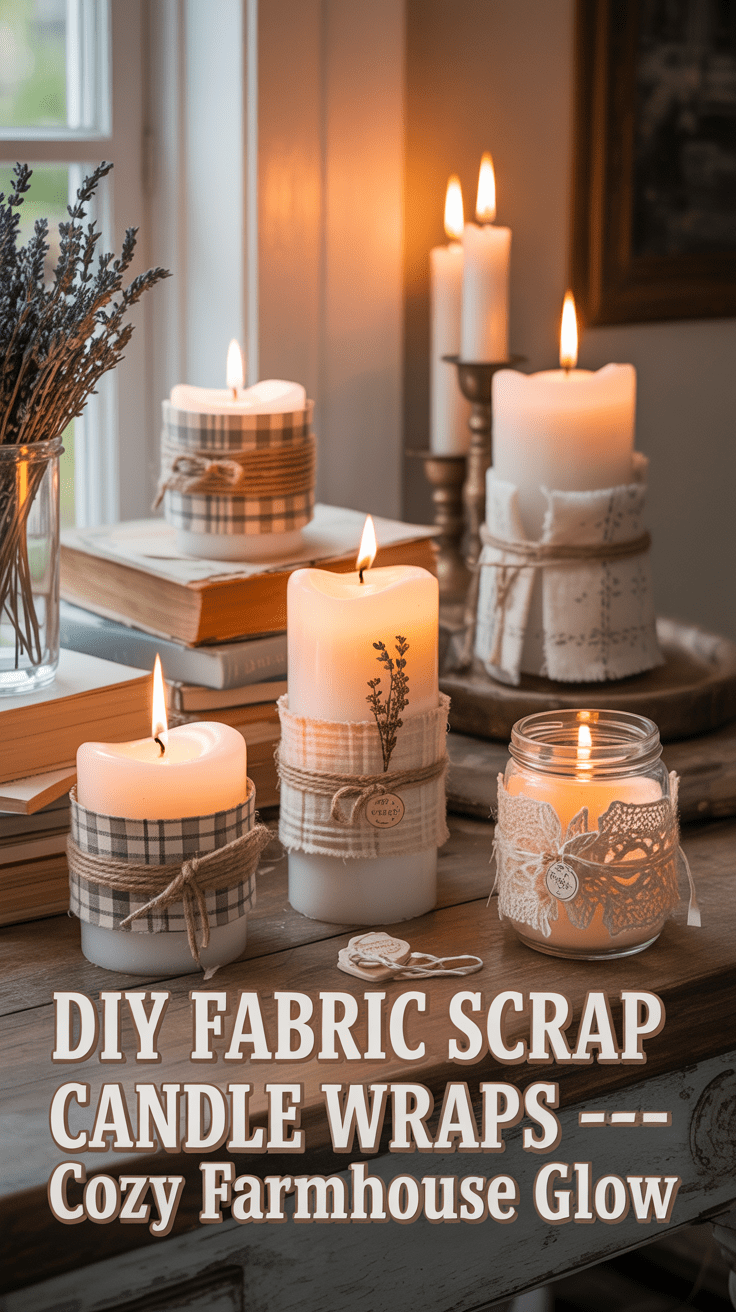
Pinterest got me again — this time with candles. I saw a photo of mason jars wrapped in fabric and twine, and suddenly I was digging through my scrap bin like a woman possessed. In ten minutes, my plain white candles looked like something from a boutique. Cozy, soft, and perfectly farmhouse.
How To:
- Grab a few pillar candles or jars (any size works, but 3–6 inches tall looks best).
- Cut your fabric scraps into strips about 2–3 inches wide and long enough to wrap around the candle.
- Use natural fabrics like cotton, linen, or burlap — they lay flat and hold shape.
- Wrap each fabric strip snugly around the candle or jar, securing the ends with a small dot of fabric glue or double-sided tape (not hot glue — it melts wax).
- For extra charm, tie a piece of twine, lace, or jute ribbon around the center.
- Optional: add a small charm, dried sprig, or wooden tag for that cozy farmhouse vibe.
Shopping List
Do: choose natural fabrics — synthetic materials can be unsafe near flame.
Do: keep wraps below the flame line for safety.
Don’t: use thick fabric that prevents the candle from standing evenly.
Don’t: glue directly onto the wax if you plan to reuse the candle — wrap around jars or holders instead.
Fabric Scrap Keychains

Sunday morning with coffee in one hand and scissors in the other. They’re the perfect project for leftover bits too small for anything else — and they make adorable gifts. I ended up with one for my keys, one for my tote, and one just because I couldn’t stop.
How To:
- Choose small fabric scraps — about 2×4 inches each.
- Cut two identical pieces per keychain and one piece of fusible interfacing for structure.
- Iron the interfacing onto the wrong side of one fabric piece.
- Place right sides together, sew around edges, leaving one short end open.
- Turn right side out, press flat with iron.
- Fold open end inward and topstitch all around for a clean edge.
- Add a key ring or swivel hook through the top using a small loop of folded fabric.
Do: use interfacing — it keeps your keychain crisp and durable.
Do: experiment with contrasting thread colors for fun stitching.
Don’t: overstuff or use thick fabric — the ring won’t close properly.
Don’t: skip ironing — it gives a clean, professional look.
Wall & tabletop details
Fabric Scrap Wall Art

Pinterest had me at “textured gallery wall,” and suddenly I was pulling fabric scraps from every drawer in the house. Denim from old jeans, lace from a dress that never fit right, linen from last summer’s tablecloth — all of it found a new home in a frame. The end result looked like something straight out of a home décor boutique, but it only cost me glue, patience, and too much coffee.
How To:
- Find a large rustic wooden frame — a shadow box, an old picture frame, or a reclaimed wood frame (roughly 18×24 inches or larger looks stunning).
- Cut fabric scraps into rough squares or rectangles — don’t trim the edges cleanly. The frayed, slightly imperfect edges are what give this piece its charm.
- Lay your fabric pieces out in a grid pattern on a flat surface to plan your arrangement. Aim for 4–5 rows with 4–5 pieces per row.
- Mix textures and patterns — plaid beside floral, linen beside gingham, velvet beside cotton.
- Stretch a piece of plain linen, muslin, or canvas over the frame back as a base and secure it with a staple gun or tacks.
- Pin or tack each fabric square directly to the base, leaving a small gap between pieces so the frayed edges show.
- Hang using the frame’s existing hardware, or thread wire across the back for a gallery-style hang.
Do: embrace frayed edges — they’re the whole look.
Do: use a variety of textures for dimension and visual interest.
Don’t: try to make every piece perfectly square — handmade irregularity is the point.
Don’t: seal with Mod Podge — this piece is meant to look raw and textile, not laminated.
Fabric Scrap Bookmarks

These sweet fabric bookmarks are perfect for anyone who can’t resist “just one more chapter.” I used floral cotton from old pillowcases and a scrap of denim from my husband’s jeans — and somehow, they look like boutique gifts.
How To:
- Cut two fabric rectangles (about 2×6 inches) and one piece of fusible interfacing the same size.
- Iron the interfacing onto the wrong side of one fabric piece.
- Cut a 4-inch piece of ribbon, lace, or coordinating fabric and fold it in half to form a loop. Place it inside the top edge of the bookmark (between the two fabric pieces, loop pointing inward) before sewing — this ribbon tab becomes the decorative pull at the top.
- Place the two fabric pieces right sides together (with the ribbon loop tucked inside the top) and sew around all four edges, leaving a 1-inch gap at the bottom to turn.
- Turn the bookmark right side out, pushing the ribbon loop out through the top. Press flat.
- Topstitch around the entire edge to close the gap and give a finished, professional look.
Do: iron as you go — crisp edges make it look professional.
Do: make the ribbon loop 2–3 inches long so it drapes nicely above the book pages.
Don’t: skip the interfacing — the bookmark won’t stay flat.
Don’t: use thick fabric that makes turning the bookmark difficult.
Fabric Scrap Garland

Pinterest told me I needed a garland for every occasion — and it was right. You can easily make one from leftover flannel, muslin, and cotton, and now it hangs across my fireplace like it’s been there forever. The best part? No sewing machine required.
How To:
- Cut fabric scraps into strips — 2–3 inches wide and 14–16 inches long. You want them wide enough to have presence and long enough to drape well.
- Don’t trim the ends clean — frayed edges are the whole aesthetic. If you want extra fraying, pull a few threads along the edges with your fingers.
- Cut a long piece of jute rope or twine to your desired garland length, plus about 12 extra inches on each end for hanging.
- Fold a fabric strip in half and tie it onto the jute with a lark’s head knot (fold the strip, place the loop over the rope, pull both ends through the loop and tighten). Repeat all the way down.
- Space knots about 1–2 inches apart for a full, lush look, or space them out more for a boho vibe.
- Mix fabric colors, patterns, and textures — floral, plaid, solid, gingham — for the layered farmhouse feel.
Do: mix fabrics with different textures and prints for visual interest.
Do: embrace the frayed ends — they’re part of the rustic charm.
Don’t: trim the fabric tails to be perfectly even — that removes the handmade feel.
Don’t: hang near open flames or candles (fabric is flammable).
Fabric Scrap Throw Pillow

Pinterest tricked me into thinking I could make a pillow “just for fun,” and now my couch has six. Mixing leftover patterns and textures gave me something store-bought couldn’t — cozy personality.
How To:
- Cut your fabric scraps into equal-sized squares (5×5 inches works great).
- Arrange them in a grid until you like the design.
- Sew the squares together, row by row, pressing seams flat.
- Sew the finished front piece to a solid back piece (right sides together), leaving one edge open.
- Turn right side out, stuff with pillow filling, and sew the opening closed.
- Optional: add pom-pom trim or tassels for extra flair.
Shopping List
Do: use similar fabric weights for even seams.
Do: iron each row flat for cleaner stitching.
Don’t: overstuff — the seams can strain.
Don’t: forget to backstitch at corners to reinforce edges.
Everyday touches
Fabric Scrap Coasters

You can make a set of these fabric coasters in one afternoon using scraps from old pillowcases and a worn-out dress. Now your coffee table looks cozy and handmade — like a little fabric story under every cup.
How To:
- Cut two 5×5-inch fabric squares for each coaster and one piece of quilt batting or felt in the same size.
- Layer them: one fabric square (right side down), batting in the middle, and the second fabric square (right side up).
- Clip or pin the layers together.
- Sew around all four sides with a ¼-inch seam allowance, leaving a small opening.
- Trim the corners, turn the coaster right side out, and press flat with an iron.
- Topstitch around the entire edge to close the opening and secure the layers.
Shopping List
Do: use cotton or linen — they handle heat and moisture best.
Do: iron before sewing for crisp edges.
Don’t: forget the batting layer — it gives body and absorbs moisture.
Don’t: skip topstitching — it keeps the shape crisp after washing.
Fabric Scrap Gift Wrap

Pinterest made me ditch paper gift wrap forever. I grabbed a few leftover fabric squares, some twine, and a sprig of rosemary — and suddenly my gifts looked like they belonged in a rustic magazine shoot.
How To:
- Cut your fabric to a size slightly larger than your gift — enough to wrap over all sides like you would with paper.
- Iron the fabric flat so you’re starting with a smooth surface.
- Place your gift face-down in the center of the fabric. Fold one long side up and over the top of the box and press it flat, just like wrapping with paper.
- Fold the short sides in neatly, tucking the corners flat against the box.
- Fold the remaining long side up and over to cover everything. Use a small piece of double-sided tape or a fabric clip to hold the fold in place while you work.
- Wrap a length of twine or jute rope around the entire package and tie it in a bow on top.
- Add finishing touches like a dried sprig of rosemary, a small flower, or a wooden gift tag tucked under the twine.
Shopping List
Do: choose fabrics that don’t slide — cotton, linen, and burlap grip the box better than satin.
Do: reuse your wraps — they’re washable and sustainable.
Don’t: wrap too loose — snug folds make the finished package look polished.
Don’t: over-decorate — the beauty is in the simplicity.
Fabric Scrap Tote Bag

Pinterest convinced me that every crafter needs a tote bag — and that I could make mine from leftovers. I pieced together denim, linen, and floral scraps, and now it’s my go-to farmers market bag. Every square is a memory from another project.
How To:
- Cut your fabric scraps into 6×6-inch squares.
- Arrange the squares in a 4×4 grid (or larger for a bigger tote).
- Sew each row of squares together, then join the rows to form the front panel. Repeat for the back panel.
- Cut two rectangles of sturdy fabric for the lining.
- Sew the lining and outer panels separately, then join them at the top edge, right sides facing.
- Turn right side out, press flat, and topstitch around the rim.
- Add two long fabric strips (2×24 inches) for handles, sewing securely to the top edge.
Do: reinforce handles with a box stitch for durability.
Do: prewash all fabrics to prevent shrinkage later.
Don’t: use thin cotton alone — it won’t hold shape.
Don’t: skip pressing seams flat — it makes your tote look professional.
Fabric Scrap Bunting

Pinterest got me on this one during spring cleaning — I had so many tiny scraps I couldn’t bear to toss. Now I’ve got cheerful bunting draped across my porch and above my sewing table, and it instantly brightens any space.
How To:
- Cut fabric scraps into triangles or pennant shapes (6 inches tall works great).
- Use pinking shears to keep the edges from fraying, or sew a quick zigzag stitch around each piece.
- Lay a long piece of bias tape or ribbon across your table and space out your fabric flags evenly.
- Fold the top edge of each flag over the tape and sew along the edge to secure.
- Keep adding flags until you reach your desired length.
- Press flat and hang with small nails or pushpins.
Shopping List
Do: alternate prints and solids for a balanced look.
Do: press seams after sewing to keep the flags neat.
Don’t: leave too much space between flags — it breaks the flow.
Don’t: hang bunting outdoors in rain — it’s fabric, not waterproof.
Grab the fabric scrap starter kit in one place
Skip the multiple searches — everything you need for these 20 projects lives in one shop-the-look link.
Shop the full supply list →Wearables & keepsakes
Fabric Scrap Aprons
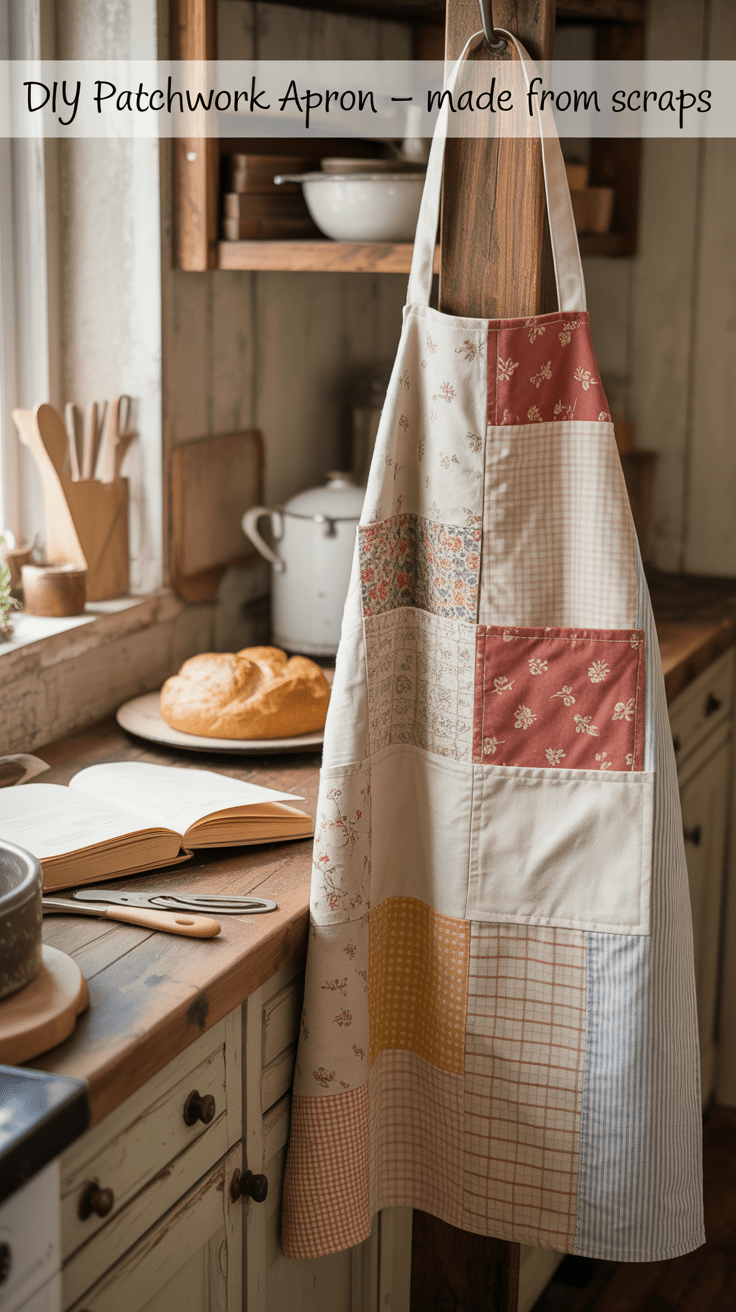
Pinterest told me a patchwork apron would make me “feel like a farmhouse goddess.” It wasn’t wrong. I used leftover floral cotton and some checkered linen from an old tablecloth, and now it’s the apron I reach for every time I bake cookies or paint furniture.
How To:
- Gather a mix of fabric scraps — cotton and linen work best for aprons.
- Cut your scraps into rectangles or squares (4×6 inches or similar).
- Sew them together into a large panel about 20×28 inches (adjust for your size).
- Cut a second piece of fabric for the back and pin right sides together.
- Sew around the edges, leaving a small opening.
- Turn right side out, press flat, and topstitch for a clean finish.
- Cut two long strips (2×30 inches) for waist ties and one shorter strip (2×20 inches) for the neck loop.
- Sew the ties securely to the top corners and sides.
Shopping List
Do: press each seam as you go for a professional finish.
Do: reinforce the ties with backstitching.
Don’t: mix stretchy fabrics with woven ones — they’ll pull unevenly.
Don’t: skip lining — it adds structure and helps your apron last longer.
Fabric Scrap Plant Hangers

Pinterest had me convinced my plants needed outfits — and now every pot in my house wears a scrap-fabric hanger. It’s the easiest no-sew project ever, and it turns boring pots into instant décor.
How To:
- Cut long strips of sturdy fabric (like denim or canvas) about 1 inch wide and 24–36 inches long.
- Group four strips together and tie a knot at one end — this will be the base.
- Separate the strips into pairs and tie a knot in each pair about 3 inches above the base.
- Cross and tie alternating strips about 3 inches higher to form the cradle pattern.
- Gather all strips together and tie a large knot at the top for hanging.
- Place your pot in the cradle and adjust knots to balance.
Do: use fabrics that don’t stretch too much — cotton canvas holds shape best.
Do: double-knot each tie for safety.
Don’t: hang heavy ceramic pots — lightweight works best.
Don’t: skip balancing before hanging — uneven knots can tip your plants.
Fabric Scrap Table Runner
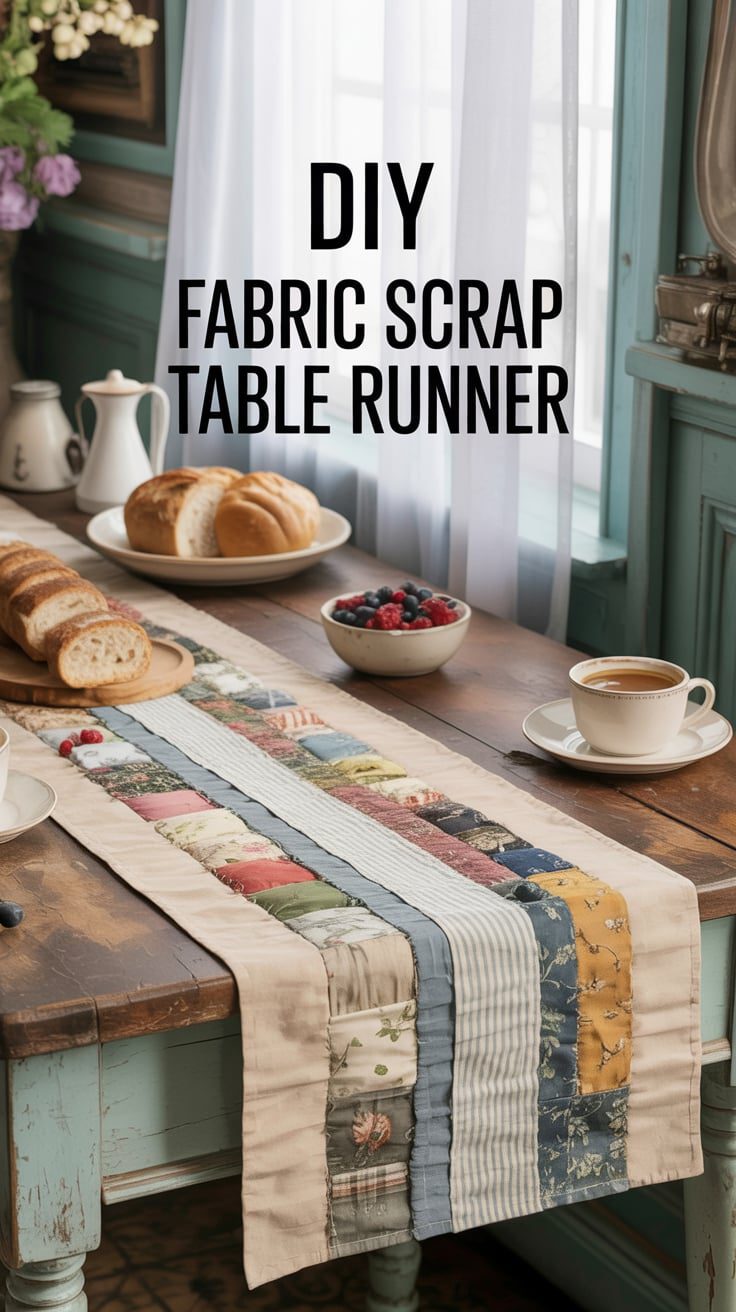
Pinterest made me think I needed a table runner for every season — so I made one that works year-round. It’s pieced together from leftover fabric napkins, a shirt hem, and even part of an old curtain. It’s perfectly imperfect and absolutely charming.
How To:
- Measure your table length; your runner should be about 12–14 inches wide and as long as your table plus 12 inches of overhang on each end.
- Cut fabric scraps into small rectangles, about 2–3 inches wide and 4–5 inches tall. You’ll need many of these — they’re what give the runner its dense, mosaic-like look.
- Arrange the pieces into vertical columns running across the width of the runner. Sew each column of pieces together (short sides joined), then sew the columns side by side until you reach your desired length.
- Press all seams flat with an iron as you work.
- Cut a piece of backing fabric the same dimensions and pin right sides together.
- Sew around all edges, leaving a small opening. Turn right side out, press, and topstitch around the entire edge to close.
Shopping List
Do: mix warm and cool tones throughout for a rich, layered look.
Do: press every seam as you go — it makes the finished runner lie flat.
Don’t: use wide strips — small pieces give the runner its patchwork character.
Don’t: skip backing — it gives the runner structure and a polished finish.
Fabric Scrap Hair Scrunchies

Pinterest made me nostalgic for the ’90s — and now I make scrunchies like it’s a sport. It’s the fastest, most satisfying project for leftover fabric, and they make perfect gifts or craft fair sellers.
How To:
- Cut a strip of fabric 18×4 inches.
- Fold it lengthwise, right sides together, and sew along the long edge to form a tube.
- Turn the tube right side out using a safety pin.
- Cut an 8-inch piece of elastic and thread it through the tube.
- Tie or sew the elastic ends securely together.
- Fold the raw fabric edges inward and sew or glue the ends closed.
- Adjust the gathers evenly and give it a quick press.
Shopping List
Do: use soft, flexible fabrics like cotton or silk blends.
Do: double-knot the elastic before sewing it closed.
Don’t: use thick denim — it won’t gather nicely.
Don’t: make the tube too narrow — it’ll be hard to thread the elastic.
Finishing touches & storage
Fabric Scrap Magnets

Pinterest made me believe I could make my fridge look cute — and honestly, it worked. I turned leftover bits of floral cotton, linen, and denim into little magnets that now hold grocery lists and photos. They look like mini art pieces, and they’re such a fun way to use tiny scraps that would’ve gone straight to the trash.
How To:
- For stuffed fabric heart magnets: Cut two heart shapes from fabric scraps, about 2–3 inches across. Place right sides together and sew around the edge, leaving a 1-inch gap at the top.
- Clip the curves, turn right side out, and stuff lightly with a pinch of fiberfill or batting scraps. Hand-stitch the gap closed. Hot-glue a small round magnet to the flat back of each heart.
- For flat fabric square magnets: Cut a fabric square about 3×3 inches. Fray the edges slightly for a rustic look. Apply a coat of fabric stiffener to the back and let dry.
- Hot-glue a round wooden disc magnet to the center of the back. Let dry completely before placing on the fridge.
Shopping List
Do: let glue dry fully before placing magnets on your fridge.
Do: use bright, patterned fabrics for a playful mix.
Don’t: overstuff the hearts — they should be lightly puffed, not hard.
Don’t: use heavy embellishments on the fronts; they add too much weight for the magnet to hold.
Fabric Scrap Key Holder
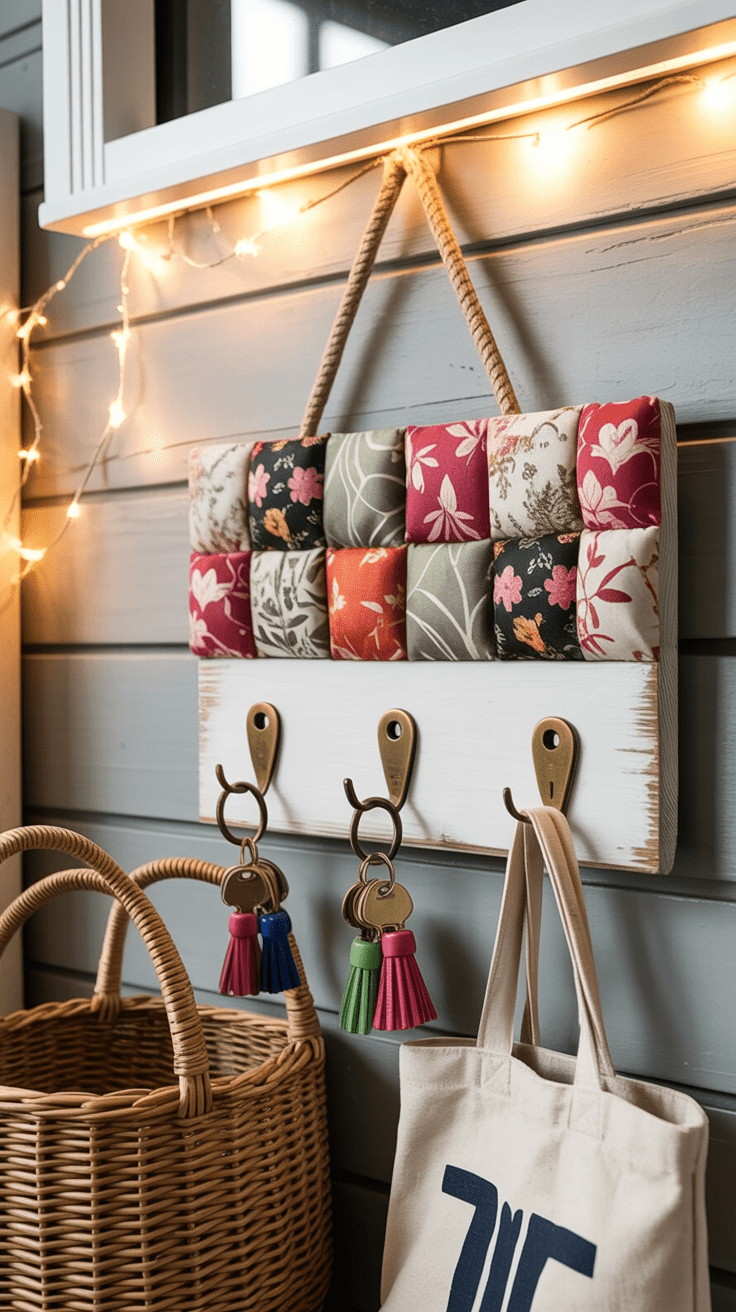
Pinterest had me convinced I needed something cuter to hang my keys — and now I have it. I made this patchwork padded key board that looks like something from an Etsy shop. It’s functional art that makes your entryway look instantly more intentional.
How To:
- Cut a piece of wood about 10×12 inches and paint or whitewash it. Let it dry fully.
- Cut fabric scraps into small 2×2-inch squares. For each square, cut two matching pieces of fabric plus a small piece of batting the same size.
- Sandwich the batting between the two fabric squares (right sides out) and sew around all four edges. Repeat until you have 12–16 padded squares.
- Arrange the padded squares in a 3–4 wide, 3–4 tall grid on the top portion of the board and hot-glue or tack each one firmly in place.
- Space and screw 3 metal hooks evenly across the lower half of the board.
- Drill a small hole in each top corner and thread a length of jute rope through both holes, tying a knot on the back of each to create a hanging loop.
- Mount to your wall using a nail or command hook through the rope loop.
Shopping List
Do: use a variety of patterned fabrics for the padded squares — mix florals, plaids, and solids.
Do: secure hooks tightly — you’ll be hanging real weight.
Don’t: use thin cardboard for the base; it won’t hold the hooks long-term.
Don’t: skip painting the wood first — the painted lower panel contrasts beautifully with the patchwork top.
Fabric Scrap Travel Pouch

Pinterest had me dreaming of cute travel organization, and this DIY patchwork drawstring pouch totally delivered. I made mine from old pillowcase fabric, denim, and floral scraps, and now I use it for jewelry, chargers, or even makeup.
How To:
- Cut your fabric scraps into rectangles of varying sizes and sew them together into a large patchwork panel, about 14×20 inches (this becomes the outer bag). Press all seams flat.
- Cut a lining piece the same dimensions from a coordinating single fabric.
- Fold the patchwork panel in half widthwise (right sides together) and sew up both side seams, leaving the top open. Do the same for the lining.
- Tuck the lining inside the outer bag with wrong sides together. Align the top edges and fold both layers down ½ inch, then fold again 1 inch. Sew two parallel channels near the top — this is your drawstring casing.
- Cut two lengths of cord or twine about 30 inches each. Thread the first cord all the way around through the channel (entering and exiting on the same side). Thread the second cord entering and exiting from the opposite side.
- Knot the ends of each cord together. Pull both cords in opposite directions to cinch the bag closed.
Shopping List
Do: use lightweight cotton or linen for easy folding and packing.
Do: reinforce side seams with a second pass for bags that carry heavier items.
Don’t: skip ironing before sewing — wrinkles make uneven seams.
Don’t: forget to knot the drawstring ends so they don’t slip out.
Fabric Scrap Storage Bins
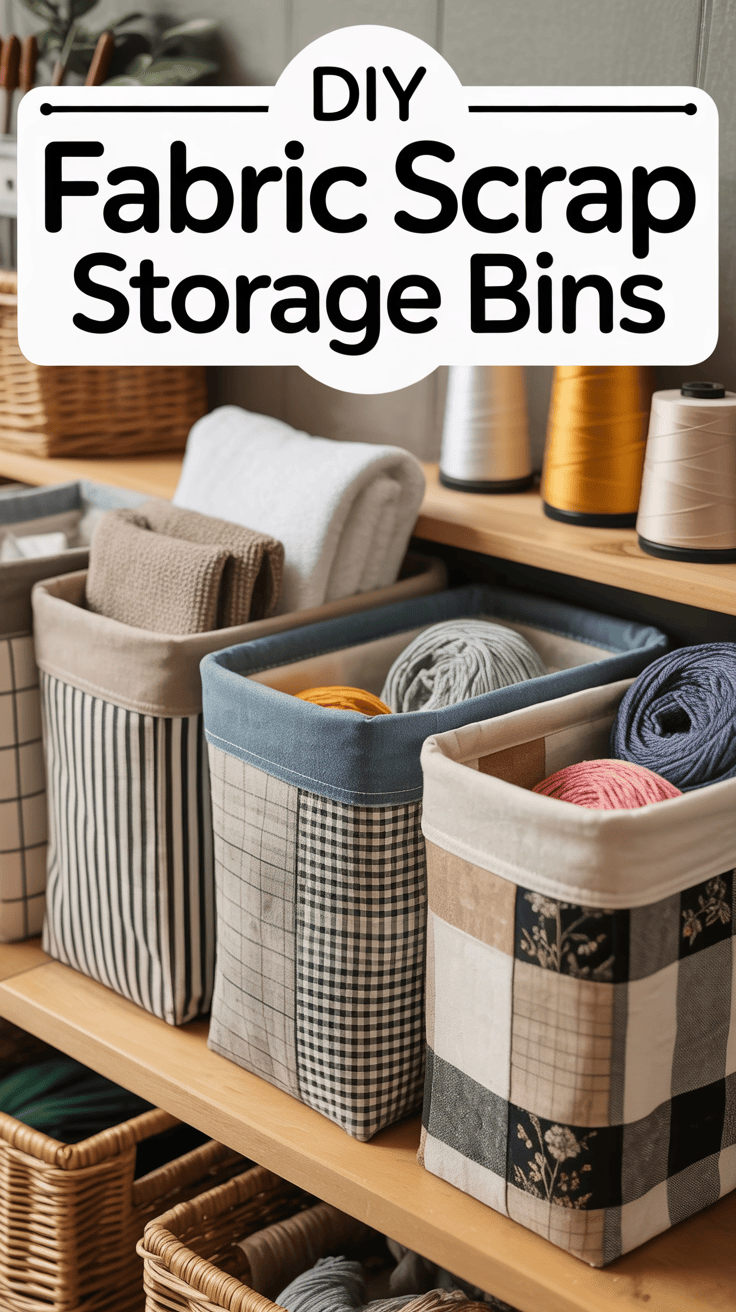
Pinterest convinced me to turn fabric leftovers into storage magic — and I’ve never looked back. These bins hold yarn, craft supplies, and even socks, all while looking like something you’d buy at Target.
How To:
- Cut two large rectangles of sturdy fabric (18×14 inches) for each bin.
- Cut matching pieces of fusible interfacing or canvas for structure.
- Iron interfacing onto the wrong sides of the outer pieces.
- Sew the short sides together to form a loop, then stitch across the bottom.
- Cut a base circle or rectangle for the bottom and attach with a tight seam.
- Turn right side out, press, and fold the top edge down about 1 inch for a finished rim.
- Optional: add handles by sewing folded fabric strips to each side.
Do: use stiff interfacing for bins that stand upright.
Do: reinforce corners for longer-lasting shape.
Don’t: use lightweight fabric unless lined — it’ll collapse easily.
Don’t: skip pressing seams — clean folds make the bins look store-bought.
Loved this? Pin it.

Hover or tap the image and hit save so you can find these 20 fabric scrap projects again next time your scrap basket overflows.
Start your first fabric scrap project this weekend
Grab a handful of scraps from your stash and turn them into something you’ll actually use.
Shop my fabric scrap supplies →This website contains affiliate links. Some products are gifted by the brand to test. As an Amazon Associate, I earn from qualifying purchases. The content on this website was created with the help of AI.
This website contains affiliate links. Some products are gifted by the brand to test. As an Amazon Associate, I earn from qualifying purchases. The content on this website was created with the help of AI.
