This website contains affiliate links. Some products are gifted by the brand to test. As an Amazon Associate, I earn from qualifying purchases. The content on this website was created with the help of AI.

How to Sell Pottery and Actually Make a Profit
A step-by-step roadmap from your first craft fair booth to a thriving online shop, so those beautiful pots finally turn into real income.
Updated August 20, 2026.
So, your shelves are overflowing with gorgeous pottery you’ve poured your heart into. You’re looking at it all and a little voice in your head is asking, “Could I actually sell this stuff and make a profit?” I’m here to tell you the answer is a resounding yes — but the path from passion to profit can feel like a maze. We’ll cover everything from the electric energy of craft fairs to the worldwide reach of online shops, step by step, so by the end you’ll have a clear, actionable roadmap to turn those beautiful pots into a real, thriving business.
Start Offline First
Craft fairs give you instant feedback, instant income, and real market research before you build a website.
Price in Three Tiers
Low, mid, and high-end “hero” pieces work together so every customer finds something to buy.
Photograph Like a Pro
Natural light, a scale shot, and a clean background do more for sales than any expensive camera.
Build an Email List
Your social following is rented land. Your email list is the one audience you actually own.
The Foundations — Physical vs. Digital
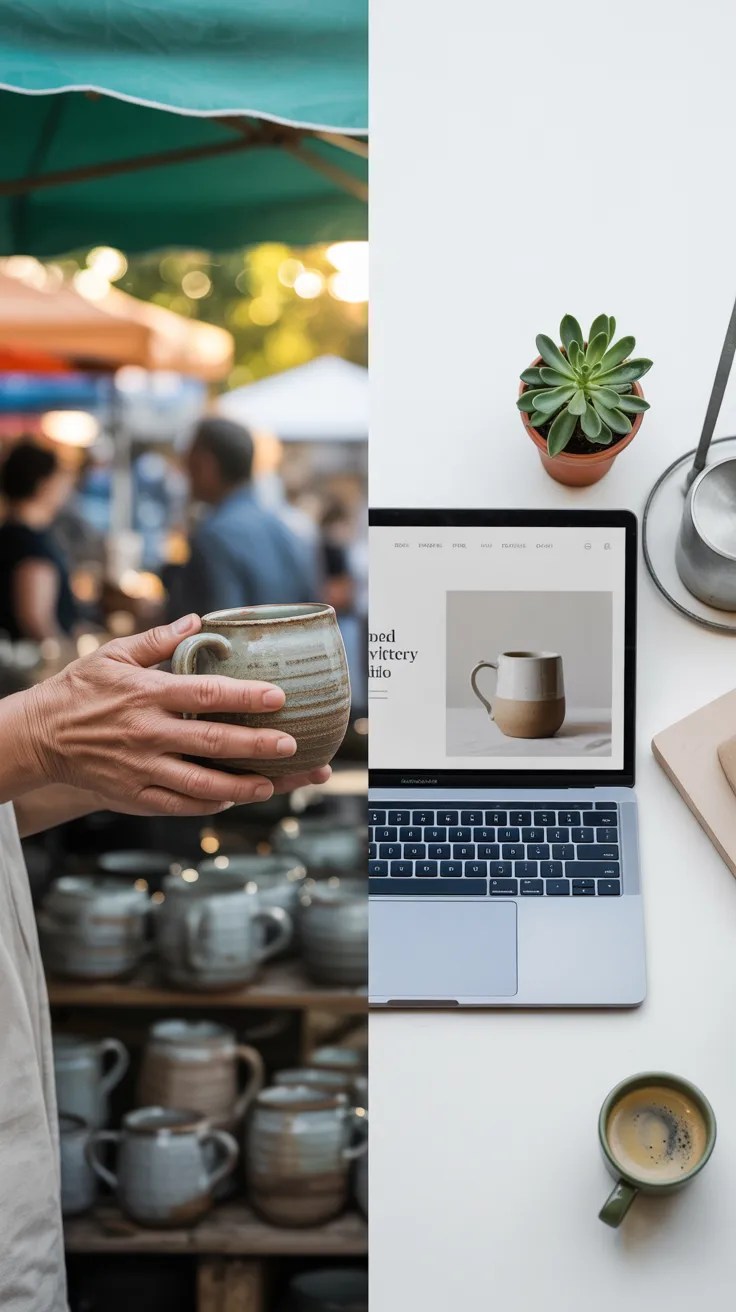
Before you touch product photography or marketing hashtags, zoom out and look at the big picture. Where are you actually going to sell your work? You’ve basically got two arenas: the physical world and the digital world — and the most successful potters are masters of both.
The physical world means craft fairs, farmers’ markets, holiday bazaars, and local boutiques — where the magic of face-to-face connection happens. The digital world is vast: Etsy’s built-in audience, your own website where you call all the shots, and social selling that turns followers into customers.
The real secret isn’t choosing just one. It’s learning to layer these strategies over time. The pottery and ceramics market is booming, and the demand is there — the best place to start is offline, in the real world.
Choose the Right Craft Fair

A craft fair can feel intimidating at first, but it’s hands-down the best place to begin. Why? Three words: immediate feedback, instant income, and invaluable market research. Online, if a product doesn’t sell, you’re left guessing. In person, you get real-time data on exactly which pieces people gravitate toward.
Not every market is the right fit. Before you apply, visit the fairs you’re interested in as a customer. What’s the vibe? Are people casually browsing with a coffee, or actively pulling out their wallets? Your mission is to find the markets where your ideal customers already spend their weekends.
Build a Booth That Sells

Your booth display is everything — it’s your first impression and can make or break your sales for the day. The single most important rule: build vertically. Get your work off the flat table and up to eye level with wooden crates, simple shelving, or tiered stands. Repurposed home storage solutions work just as well as “professional” merchandising and cost far less.
Keep the display clean. Group similar items together — all the mugs here, all the planters there. Use a tablecloth that makes your pottery pop. And make sure every single item has a clear price tag; customers who can’t easily see the price will often just walk away.
Price for Every Budget
The most profitable booths offer something for everyone at multiple price points — low, mid, and high.
Your low-priced items (under $20, sometimes under $10) are impulse buys: ring dishes, magnets, ornaments, ceramic buttons. They sell fast and get your work into more hands — someone who buys a $10 magnet today might come back next year for a $60 mug.
Your mid-range products — classic mugs, bowls, small planters — are your bread and butter.
And you need one or two high-end “hero” pieces. A large, intricate vase might not even sell at the market, but it works as a price anchor: next to a $300 vase, a $65 mug suddenly feels like a bargain.
Sell the Story, Not Just the Pot

You are the story behind the work, so don’t just stand there silently when someone picks up a mug. Say something like, “I’m so glad you picked that one up — the way the glaze ran in the kiln created such a cool, one-of-a-kind pattern.” Tell them about your process, your inspiration, or what makes that piece special. People are buying a piece of your story.
Small signs help tell that story for you, too. A simple card that reads “Food & Microwave Safe” or “The Perfect Wedding Gift” answers questions and plants ideas before a customer even asks.
Promote Before You Show Up
Don’t rely on the event organizer to do all the marketing — it’s your job to promote your own attendance. Post on social media in the weeks and days leading up to the event, share sneak peeks of the new work you’ll be bringing, and create a Facebook event to invite everyone you know. The more you promote, the more friendly, familiar faces walk into your booth ready to buy.
Photography Is Everything
You don’t need a fancy camera to start — your smartphone is more than capable once you understand light and styling. Bad photos will kill your sales no matter how beautiful your pottery is.
Natural, indirect daylight is your best friend. Set up near a large window, out of harsh direct sun, and turn off the overhead lights — they cast a yellowy glow. Use a neutral background: white paper, a plain wall, or linen fabric.
Shoot every angle, and always include a “scale shot” — hold the mug in your hands, or place a flower in the vase — so the customer instantly understands the size. Get both a clean product shot and a styled lifestyle shot, then do light editing in a free app like Canva.
Etsy vs. Your Own Website
Think of it in phases. Starting with Etsy is fantastic for beginners — millions of buyers are already there searching for handmade items, and you can have a shop running in an afternoon. The downsides are the fees and the competition, so think of Etsy as a launchpad, not the final destination.
Your own website, on a platform like Shopify or Squarespace, is the long-term goal: total control, no competitors on the page, deeper customization, and better margins since you aren’t paying commission on every sale. The tradeoff is you’re responsible for 100% of the traffic — which is why it’s worth building your own site after you’ve already got some momentum from markets and social media.
Ready to build a booth that actually sells?
The Secret Weapon: Your Email List
If you take one piece of advice from this whole guide, let it be this: start an email list from day one. Your social media following is rented land — an algorithm change can wipe it out overnight. Your email list is an asset you own.
Use a free tool like Mailchimp or Flodesk. Put a signup form on your website, and have a physical signup sheet at your booth — even offer a small giveaway for those who join. Treat your subscribers like VIPs: they should be first to know about new collections and get exclusive access or discounts.
The Art of the “Shop Update” Launch
Many successful potters don’t just have items for sale all the time — they build anticipation and launch curated “shop updates” that create scarcity and a rush of sales.
Decide on your collection’s inventory, then batch-photograph and edit it all at once. Create a “Coming Soon” preview on your website so your audience can browse and plan their purchase ahead of time. A day or two before launch, email your list the exact date and time — some potters even give early access as a loyalty reward. On launch day, shout it from the rooftops with countdown timers and your best photos.
Marketing Without the Overwhelm
Marketing can feel like a full-time job. The key is not spreading yourself too thin — when you’re starting out, pick one visual platform and get really good at it. For pottery, Instagram or Pinterest are usually the best bets.
Your content shouldn’t be a constant stream of “buy my stuff.” Show the process instead — throwing on the wheel, trimming a foot, glazing a piece. That behind-the-scenes authenticity is what makes people fall in love with your brand. Consistency matters far more than intensity: find a rhythm you can actually sustain and stick with it.
Your 5-Phase Roadmap
Here’s the phased approach for building a profitable pottery business from the ground up:
- Start with in-person markets. Get crucial direct feedback, generate your first sales, and learn what customers actually want.
- Open an Etsy shop at the same time. Reuse your market photos to list your items as a secondary, more passive sales channel.
- Choose one social media platform and consistently build your audience by sharing your journey and process.
- Build your own website once you’re making regular sales — this becomes your primary channel, where you have total control.
- Nurture your email list from day one. It will eventually become your single most valuable marketing tool.
The Pottery Entrepreneur Mindset
You’re going to face moments of doubt — imposter syndrome, that nagging feeling you’re not “good enough” to sell your work. Don’t wait for perfection. Some of the best-selling pieces are slightly “wonky”; customers who seek out handmade items appreciate the mark of the human hand, not sterile factory perfection.
Pricing will feel like a hurdle too. Calculate your real costs (clay, glazes, firing, packing) and pay yourself a fair hourly wage. See what similar potters charge, and don’t underprice your work — it devalues your own skill and the whole craft community.
Being a small, independent artist is your superpower. You can tell your story, connect with customers personally, and build a genuine community around your art — something no giant corporation can ever replicate.
TL;DR — The Quick Recap
- Marketing & Mindset: Focus on one visual platform, show the behind-the-scenes process, and don’t wait for perfection.
- Start Offline: Begin with in-person craft fairs for immediate feedback, instant income, and real market research.
- Layer Your Strategy: Use physical markets as your foundation, then expand into Etsy and eventually your own website.
- Master the Presentation: Build displays vertically and price everything clearly in person; use natural light and scale shots online.
- Diversify Pricing: Offer low-cost impulse buys, mid-range bread-and-butter items, and a high-end hero piece to anchor value.
- Build an Owned Audience: Start an email list from day one so your reach never depends on an algorithm.
Frequently Asked Questions
Do I need an expensive camera to sell pottery online?
No. A smartphone is enough as long as you use natural, indirect light, a neutral background, and always include a scale shot so buyers understand the size of the piece.
Should I start on Etsy or build my own website first?
Start on Etsy. It gives you a built-in audience and an easy way to test your products, pricing, and photos before you take on the work of driving 100% of your own traffic to a personal website.
How should I price my handmade pottery?
Calculate your real costs (clay, glazes, firing, packaging) and pay yourself a fair hourly wage, then check what similar potters with your experience level charge. Underpricing devalues your skill and the whole craft community.
What if my pottery isn't perfectly symmetrical?
That’s usually a selling point, not a flaw. Customers who seek out handmade pieces appreciate the mark of the human hand instead of factory-made perfection — some of the best-selling pieces are the slightly “wonky” ones.
Why does everyone say to start an email list?
Because it’s the one audience you actually own. Social media followings are “rented land” that an algorithm change can wipe out overnight, while your email list stays yours and becomes your most valuable long-term marketing tool.
Save this for your next market weekend.
Your Pottery, Your Business
Start with one craft fair, one honest price tag, and one email signup sheet. The rest of the roadmap builds from there.
This post contains affiliate links. As an Amazon Associate, Ballen Blogger may earn from qualifying purchases at no extra cost to you. Updated August 20, 2026.
This website contains affiliate links. Some products are gifted by the brand to test. As an Amazon Associate, I earn from qualifying purchases. The content on this website was created with the help of AI.
