This website contains affiliate links. Some products are gifted by the brand to test. As an Amazon Associate, I earn from qualifying purchases. The content on this website was created with the help of AI.
Imagine this: You open your fridge, hunting for leftover pizza, and your eyes land on it. Pushed to the very back, behind a wall of expired yogurt, is a ghost. The ghost of sourdough past. It’s your starter. You haven’t touched it in… well, you’ve lost track. Weeks? Months? Maybe even a year. A wave of guilt washes over you. You see the dark, murky liquid pooled on top, the complete and utter lack of bubbles, and you think, “It’s over. I’ve killed it.”
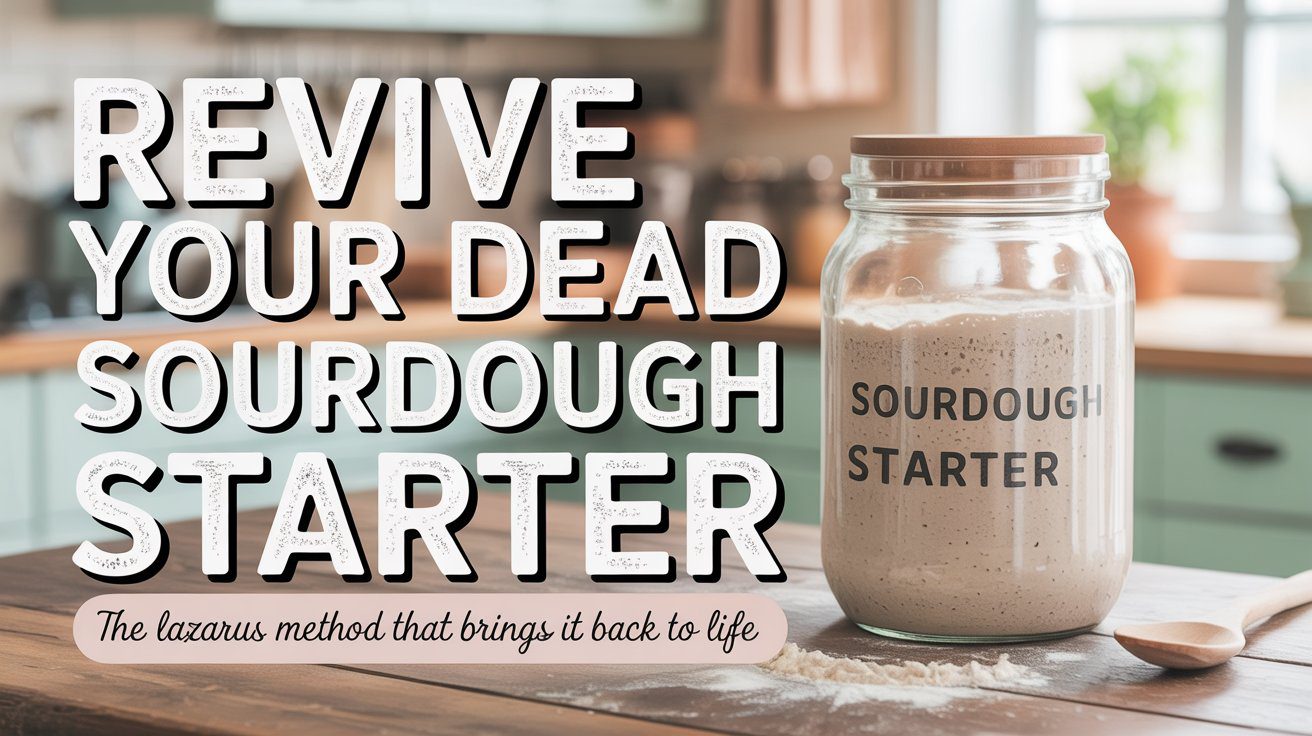
But this isn’t an ending; it’s a second chance. That sad, neglected jar of goo isn’t dead, but just sleeping. With a simple, almost miraculous technique, you can bring it back to life—not just as it was, but stronger, more resilient, and packed with a depth of flavor you never thought possible. This isn’t wishful thinking. This is the Lazarus Method. With a little patience and a little faith, your sourdough will rise again.
Today, we embark on a journey of resurrection. What many see as a failure is actually a secret weapon. The flavor that comes from a revived starter is something truly special—a deep, tangy profile that you just can’t get from a young, constantly-fed starter. So forget the guilt and forget the fear. Let’s bring your starter back from the brink. Go grab that forgotten jar, dust it off, and let’s perform a miracle.
The Health Check: Is It Truly Dead?
You’ve got the jar. It probably doesn’t look pretty. There might be a layer of dark liquid on top, and the starter itself looks dense, gray, and lifeless. The first, and most important, step in the Lazarus Method is the health check. We need to figure out if our starter is a candidate for resurrection or if, in some rare cases, it has truly gone to the great compost heap in the sky.
The Only Dealbreaker: Identifying Mold
Listen carefully: there is really only one sign that a sourdough starter is beyond saving. And that sign is mold. Inspect the surface of your starter very closely. Look for any patches of fuzz. Mold can be black, green, blue, white, or even a pinkish-orange color. It will be a distinct, often fuzzy or hairy growth on the surface or on the dried-out bits clinging to the sides of the jar. If you see any of this—any fuzzy, colored growth—the journey ends here. Mold can contain harmful bacteria, and its spores can permeate the entire starter. Please, do not try to scoop it off or save it. It’s time to say goodbye and start fresh. It’s a sad moment, but it’s crucial for your safety.
A Sign of Hunger, Not Death: Understanding Hooch
But what if all you see is that dark, slightly ominous-looking liquid? Congratulations, you’re looking at what bakers call “hooch.” Hooch is basically sourdough moonshine. It’s alcohol, a natural byproduct of the wild yeast fermenting the flour in your starter. It is not a sign of death or rot. It is a sign of hunger. Your starter has eaten all the available food, and the hooch is its way of screaming, “I’m starving!” The color can range from clear to gray to almost black; the darker it is, the longer it’s been hungry. So, if you see hooch, no matter how dark, what you should feel is not fear, but hope. It’s a clear signal that the yeast and bacteria were alive and kicking.
The Smell Test: Acetone vs. Putrid
Now, let’s talk smell. Open the jar. Be brave. A long-neglected starter is going to smell intense. It will likely be very, very acidic, like strong vinegar, gym socks, or, most commonly, nail polish remover or acetone. This sharp, pungent smell is perfectly normal. It’s the result of an imbalance in the acids produced by the bacteria. It does not mean it has gone bad. A truly contaminated starter will smell putrid, rotten, or meaty. You will absolutely know the difference. Trust your instincts. A sharp, acetone smell is just a cry for help; a rotten smell is a death certificate.
The First Act of Resurrection: The Critical Initial Feeding
This is where the magic really begins. We’ve determined our starter is a survivor, and now we need to give it its first meal. This first feeding is the most critical step. Think of it this way: you wouldn’t give a seven-course feast to someone who’s been lost in the desert. We’re going to do the same for our starter.
Step 1: Pour Off the Hooch
You have two options: pour it off or stir it in. For a long-neglected, highly acidic starter like ours, however, I strongly recommend pouring most of it off. The hooch is extremely acidic and full of waste products. By removing it, we’re instantly giving the yeast a cleaner, less stressful environment to wake up in. This one simple action can significantly speed up the revival.
Step 2: Use a Clean Jar and the “Scrapings Method”
Next, get a clean jar. Don’t try to revive your starter in the same crusty old jar. Now, we’re going to take a very, very small amount of the old starter. This might feel wrong, but that old jar is mostly waste and dormant cells. We want the strongest, most viable core of that culture. Scrape away the top layer of starter. Go deeper and scoop out just a small spoonful—we’re talking about 5 to 10 grams (about one teaspoon). That’s it. All you need is a tiny spark. The rest of that old starter can be discarded.
Step 3: Master the High-Ratio Feeding (1:5:5)
A kitchen scale is non-negotiable for consistency. For this first feeding, we’re using a high feeding ratio. A standard feeding is 1:1:1, but our starter is weak and the environment is acidic. We need to dilute that acidity and provide tons of fresh food. We’ll use a ratio of 1:4:4 or even 1:5:5. This means for every one part of starter, we add four or five parts of flour and water.
For example: Place your clean jar on the scale and tare it to zero. Add 5 grams of your old starter. Now, add 25 grams of flour and 25 grams of water. That’s a 1:5:5 ratio.
Step 4: Choose the Right Flour and Water
For this crucial first feeding, give it a nutrient boost. I highly recommend using at least some whole wheat or rye flour, as whole grains contain more minerals and microbes that act like a superfood for sleepy yeast. You could use 15 grams of bread flour and 10 grams of rye, for instance. For the water, use filtered water that is lukewarm, around 78-82°F (25-28°C). The warmth helps gently wake up the yeast. Avoid chlorinated tap water.
The First Feeding: A Step-by-Step Summary
Pour off most of the hooch.
In a clean jar, place a tiny amount (5-10g) of the old starter.
Add flour and water at a high ratio, like 1:5:5 (e.g., 5g starter, 25g flour, 25g water).
Stir everything together into a smooth, thick paste and scrape down the sides.
Cover the jar loosely—just rest the lid on top or use a cloth.
Place your starter in a warm spot, ideally between 75-80°F (24-27°C). An oven with the light on works well.
And now, we get to the hardest part: the waiting game.
The Waiting Game: A Test of Patience and Observation
You’ve performed the first rite. You’ve given your starter its first meal and tucked it into a warm bed. Let me tell you something you need to hear: it will probably do absolutely nothing for a while. And that is 100% normal.
Don’t Panic: Why It Takes Time
After severe neglect, the population of wild yeast and bacteria is incredibly low. They are just waking up and beginning the long process of reproduction. This takes time. You’ll likely see no activity for the first 12 hours, maybe not even for the first 24. I’ve had starters take a full 48 hours to show the faintest sign of life. This is the great test of a baker’s patience. Resist the urge to panic. Trust the process.
How to Spot the First Signs of Life
Your job now is to be an observer. You’re not looking for a dramatic doubling in size. Instead, look for tiny, pinprick bubbles on the surface or against the glass. You might see just one or two at first. This is a huge victory. Pay attention to the smell, too. The sharp acetone scent will slowly start to fade, shifting to a milder, yeasty, or beer-like scent. You might also see a slight change in texture as the dense paste becomes a little lighter.
The Rubber Band Trick: Tracking Your Progress
Here’s a great trick: After you feed the starter, level the surface and wrap a rubber band around the jar to mark the starting height. This gives you an objective measure of any rise, no matter how small. It’s incredibly encouraging to see it has risen just a quarter of an inch.
The Golden Rule: Do Not Feed It Again (Yet)
Typically, within 24 hours, you should see some sign of life. If after 48 hours you see absolutely zero activity, it’s possible the culture was too far gone, but this is very rare. During this waiting period, do not be tempted to feed it again. The starter needs time to work through its first meal. We wait for the signal that it’s ready for more. And that signal is activity.
Building Momentum: The Subsequent Feedings
You’ve seen the sign—a few tiny bubbles, a slight puffiness, or a rise above your rubber band marker. That’s the green light. Our goal now is to build on this spark and turn it into a roaring fire of fermentation. This phase is all about rhythm and building strength.
Timing Your Feedings Based on Activity
The timing of this second feeding is key. Don’t wait for the starter to double; it almost certainly won’t yet. You feed it at the first sign of life. If you see bubbles 24 hours after the first feeding, that’s when you feed it again. If it takes 36 hours, that’s fine too. The starter sets the schedule.
The Rhythm of Revival: Discard and Feed
For this second feeding, and the next few that follow, stick to a similar process. In a clean jar, discard most of your awakening starter, saving just a tablespoon or so (about 10-15 grams). This is essential for removing waste products and encouraging vigorous reproduction.
We’ll continue with a high feeding ratio to keep diluting any sluggishness. A 1:3:3 or 1:4:4 ratio is perfect. If you keep 10 grams of starter, you would then add 30-40 grams of flour and 30-40 grams of warm, filtered water. Keep using a bit of whole grain flour, but you can start increasing the proportion of your main bread or all-purpose flour. Mix it up, scrape down the sides, put the rubber band back on, and return it to its warm spot.
The Goal: Reaching a Predictable Peak
What you should notice is that the revival process speeds up with each feeding. The first signs of life might have taken 24 hours, but after the second feeding, you might see bubbles in just 12-18 hours. The smell will also continue to improve dramatically. Your goal is to reach a point where your starter reliably doubles in size within 4 to 8 hours in a warm environment. This is the benchmark we’re aiming for. The routine for the next 2-5 days is: wait for activity, discard, feed, keep warm, and repeat.
The Payoff: The Resurrection Bake
This is the moment. Your starter now reliably doubles in size and smells sweet and tangy. It is ready to make incredible bread. This isn’t just a bake; it’s a celebration.
Is It Ready? Using Your Starter at its Peak
To confirm its readiness, use your starter at its “peak”—when it’s reached its maximum height and is full of bubbles. The classic “float test” (dropping a spoonful in water to see if it floats) can be a fun indicator, but the real test is its predictable rise. If it has doubled in 4-8 hours, it has the strength to leaven your dough.
The Bake: From Mixing to Oven Spring
Now, let’s mix a loaf. We start by mixing the dough: your active starter, water, flour, and salt. After a brief rest, we begin stretching and folding. With each fold, you’ll notice the dough developing strength and bubbles forming. During bulk fermentation, you’ll watch this dough—made from a starter that was once a forgotten relic—confidently rise until it’s puffy and jiggly. After shaping, it goes into a banneton for its final proof.
The Grand Finale: Baking Your Loaf
The grand finale. We preheat a Dutch oven until it’s screaming hot. We gently turn our dough out, score the top, and lower it into the pot. That first 20 minutes with the lid on is where “oven spring” happens. When you take that lid off, you’ll be greeted by a loaf that has sprung up beautifully. After another 20 minutes, pull it from the oven. As it cools, you’ll hear it “singing”—a series of tiny crackles as the crust contracts. This is the sound of victory.
The Taste of Victory
The ultimate proof is inside. After it cools completely, slice into it. The crust shatters, revealing an open, airy crumb that is soft, custardy, and glistens. But the flavor is the true reward. Bread made from a revived starter has a depth and a pronounced sour tang you can’t get from a young, mild starter. It speaks of its long journey and its resilience. You did it.
Your Sourdough Has Risen Again
We started with what looked like a culinary failure and ended with a stunning loaf of sourdough. The Lazarus Method is more than a technique; it’s a philosophy. It’s a testament to nature’s resilience and a reminder that what looks like an ending is often just a new beginning. Your starter is not fragile. It’s a tough, robust colony that can withstand incredible neglect.
So the next time you discover that forgotten jar, don’t feel guilt. Feel excitement. Remember the steps: check for mold, pour off the hooch, start with a tiny scraping, use a high feeding ratio, keep it warm, and be patient.
What’s the story of your neglected starter? How long has it been sitting in your fridge? A month? Six months? A year or more? Let us know in the comments below. There’s no shame in sourdough neglect here—only tales of resurrection!
Now that your starter is vibrantly alive, the journey continues. Happy baking.
This website contains affiliate links. Some products are gifted by the brand to test. As an Amazon Associate, I earn from qualifying purchases. The content on this website was created with the help of AI.